
Cyber Attribution Evidence: When Technical Indicators Do Not Prove Identity

A source IP address, a familiar malware family or a match to a threat-intelligence report can make an attribution theory appear compelling. But none of those indicators, standing alone, normally answers the most consequential question: who actually conducted or directed the intrusion? The central discipline in cyber attribution is to separate technical association from identity […]
When Deleted Does Not Mean Gone: Preservation Risks in Cloud and Ephemeral Messaging Systems

For counsel and investigations professionals, the phrase “the account was deleted” does not necessarily answer the evidentiary question. Content may have moved from a user-facing system into a deletion queue, recycle bin, versioned object store, backup or another system. Conversely, a platform may have permanently purged content, or an encrypted messaging service may never have […]
From On-Chain Activity to Defensible Identity Attribution

Blockchain activity can be highly visible without being personally identifiable. A public ledger may show the movement of assets, the addresses involved, the timing of transactions and interactions with contracts. It does not, by itself, establish who controlled an address or what a person intended. For litigation lawyers and investigations professionals, the central issue is […]
Software Implementation Disputes: What Digital Evidence Can Establish

Software disputes often begin with a simple question: what was delivered, configured, tested or adopted, and when? The answer is rarely contained in a single contract, ticket or system log. It is usually distributed across technical environments, project records, acceptance materials and communications between the parties. A defensible assessment therefore requires more than identifying a […]
O que uma extração forense de celular realmente demonstra sobre uma mensagem?

Uma mensagem encontrada em um celular apreendido pode parecer uma prova direta de que determinada pessoa escreveu e enviou aquele conteúdo. Tecnicamente, porém, essa conclusão exige separar o que foi observado no dispositivo daquilo que se pretende afirmar sobre sua origem, autoria, contexto e integridade. Uma extração pode produzir registros de aplicativos, bases de dados, […]
When Can a Cloud or SaaS Export Support a Defensible Conclusion?

A provider-issued export can appear authoritative. It may contain timestamps, account activity, messages, audit events or records of changes. In a dispute, however, the central question is not simply whether the export is intact as a file. It is what the export represents, what it does not represent, and whether another investigator could understand the […]
After a Senior Employee Departs: Preserving Digital Evidence Across Cloud, Collaboration and BYOD

When a senior employee leaves for a competitor, the first question is often whether confidential information was copied. The more immediate question is narrower and more important: what evidence may disappear before that question can be examined properly? Audit records may have limited retention. Cloud activity can continue after departure. A personal device may contain […]
What Non-Native Digital Artefacts Can—and Cannot—Establish
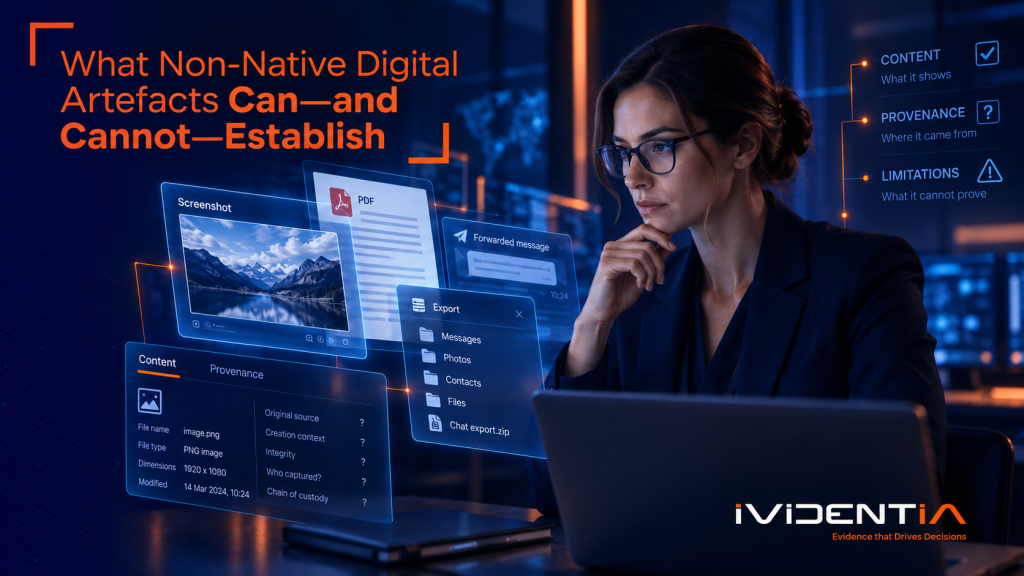
Screenshots, forwarded messages, PDFs, copied files and platform downloads often arrive in a case before the original device, native file or complete metadata is available. They may appear clear and persuasive. The practical question is what the artefact can reliably establish, what it cannot establish on its own, and what further acquisition or corroboration may […]
Preserving Ephemeral Collaboration Data Before It Disappears

When a dispute or investigation begins to take shape, relevant communications may not exist in one convenient archive. They may be distributed across a collaboration platform, individual devices, cloud storage, provider exports, third-party integrations and administrative records. Some content may also be subject to automatic retention rules, account changes or deletion workflows. The practical problem […]
What is an expert report?

The expert report is an official document with a technical-scientific basis through which the official/judicial expert reports, in writing, the method used, the results obtained, and the conclusions reached in the expert examination; that is, it is the expression of the special knowledge inherent to the forensic scientist after carrying out investigations and expert examinations.


